When an industrial coating in a Kansas City plant rusts, blisters or peels early, the cause is usually under the paint or in the film itself: a surface that was not cleaned well enough, salts left on the steel, a film applied too thin or too thick, or a coating that was wrong for the exposure.
Rust coming through: what corrosion is doing
Rust showing through a coating means water and oxygen have reached the steel. NASA's corrosion laboratory defines corrosion as the degradation of a metal due to a reaction with its environment, and explains that iron, once refined from ore, is unstable and tends to revert to a mineral form. A Federal Highway Administration study of bridge steel adds that steel corrodes when exposed to moisture and oxygen, and much faster when salts are present.
A coating's job is to keep those things away from the metal. When rust appears, the coating has stopped doing that job somewhere, and the useful question is where and why.
Poor surface preparation
Many early failures start under the paint. The federal study calls surface preparation an integral step and states that coating is applied to clean steel to prevent premature failure caused by an inappropriately prepared substrate. Preparation has two purposes in that study's words: remove contaminants, and create a specific roughness so the coating can contact and adhere to the steel.
Miss either one and the coating starts with a weakness. Oil, rust or loose paint left on the surface means the new coat is bonded to something that is not bonded to the steel. A surface that is clean but smooth gives the coat too little to grip. The surface preparation standards guide explains the written cleanliness grades.
Salts left under the coating
Some contamination cannot be seen. The federal study reports that varying amounts of contaminants, particularly chlorides, are almost always present on blast-cleaned steel, especially on existing structures prepared for recoating in the field. It cites a Society for Protective Coatings document, SSPC-TU 1, as recognizing that high concentrations of salts are harmful to protective coatings and can lead to blistering and premature failure. And it notes that no industrial standard sets a maximum amount of salt allowed on steel before coating.
In the study's own results, chloride on the steel lowered the starting adhesion of one three-coat system, and the conclusions state that chloride on the substrate affected coating performance. Steel near road salt, washdown chemicals or outdoor exposure is where this matters most.
Film too thin or too thick
Each coat has a target thickness, and missing it in either direction causes trouble. The federal study calls dry film thickness an important measure of performance: too thin, and the steel underneath is not protected; too thick, and solvents can be trapped in the film, and the coating may crack or fail to cure properly.
The study saw the thin side play out. One system was applied far thinner than its maker recommended, and the report says its poor performance could be attributed to the insufficient film. Surface blisters, rust pits and rust creeping out from a scribed line developed on some of those panels.
Edges, welds, bolts and crevices
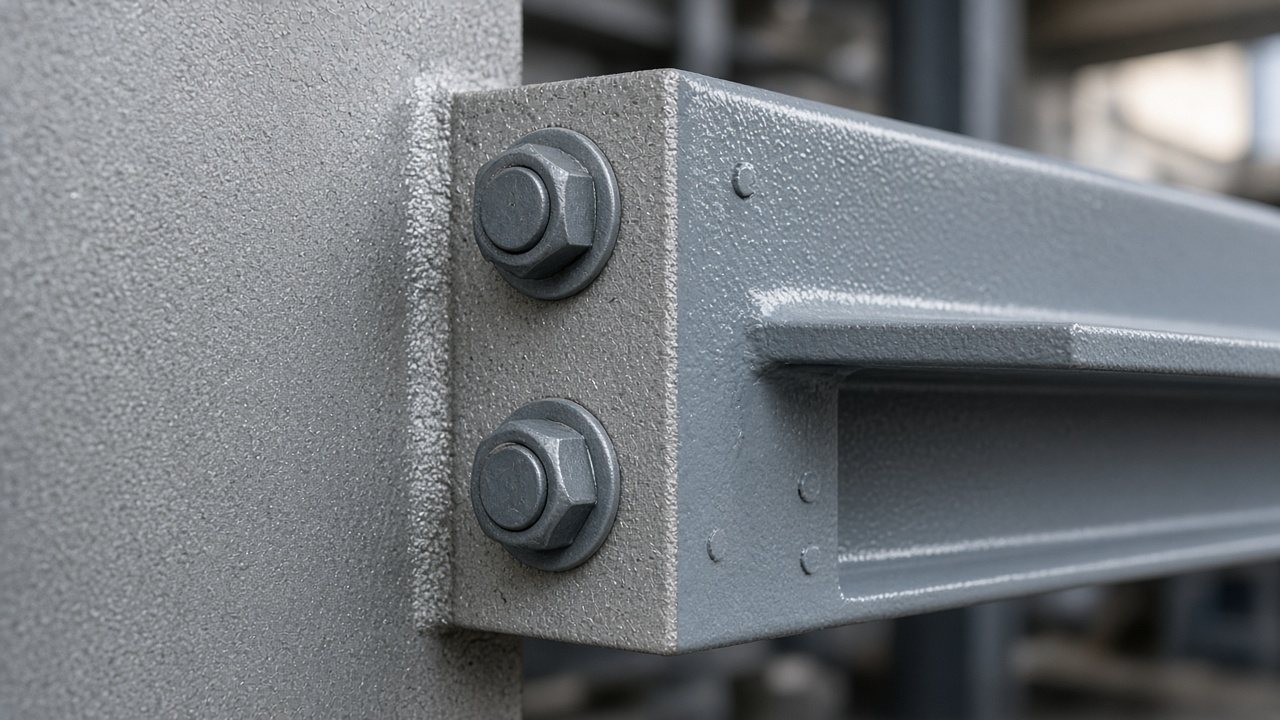
Coatings are weakest where steel is not flat. In the federal study, edges, welds, bolts and nuts were stripe painted, meaning they got an extra coat by brush before the full coat. The larger test panels carried welded and bolted attachments so the study could see how coatings perform at crevices and interfaces, and on one system's panels, the film on a V-shaped welded attachment measured thinner than on other parts of the panel.
Wet coating draws back from sharp edges as it dries, bolt threads and weld spatter are hard to wet fully, and crevices hold water against the steel. When rust shows first along edges and around bolts, the coating was likely thin there from the start. The structural steel and equipment painting page covers how those details are handled.
Peeling and loss of adhesion
Peeling is a bond failure. The federal study says adhesion is frequently considered the most prominent requirement for a corrosion-resistant coating, and in its tests, chloride contamination lowered the starting adhesion of a three-coat system. A coat that peels in sheets has usually let go of whatever was under it: contamination on the steel, a smooth surface with no profile, or an older coat that was itself failing. Look at the back of a peeled flake: if it carries old paint or rust, the problem was the layer underneath.
Sun and weather on the topcoat
The topcoat takes the sunlight so the lower coats do not have to. The federal study says the topcoat protects underlying layers against deterioration caused by ultraviolet radiation and improves appearance, and that gloss reduction indicates the film has degraded. All coatings lose gloss over time, but high quality UV-resistant topcoats can retain gloss for a long time in a properly applied system. A dull, worn topcoat on outdoor steel or a silo shell is the early warning before the barrier coat is exposed. The silo painting page covers outdoor shells.
The wrong coating for the exposure
A good coating in the wrong place still fails. Federal rules list the extreme conditions industrial maintenance coatings are made for (40 CFR 59.401), and they make a useful checklist of what a surface may be up against:
- Immersion in water or chemical solutions
- Exposure to corrosive agents
- Repeated exposure to temperatures above 250 °F
- Repeated heavy abrasion
- Exterior exposure of metal structures
Above 400 °F, continuous or intermittent, high temperature coatings are their own category. A coating chosen for a dry interior will not hold up on steel that faces several of these at once. The coating systems guide explains how systems are matched to exposure.
Standing water and poor drainage
Some failures are designed in. NASA's corrosion control page notes that drainage is one of the considerations often overlooked in designing manufactured products, and that water and debris that collect cause corrosion. Flat ledges, pockets in channel and angle, and tops of beams under a leak hold water against the coating long after everything else has dried. Recoating those spots without fixing the water only restarts the clock.
Repair or recoat: read the failure before pricing the fix
The right repair follows from the cause. Rust spots on an otherwise sound coating may only need local cleaning and touch-up: the hand and power tool cleaning standards (SP 2, SP 3) remove loose rust and paint while leaving tight coating in place, and brush-off blast cleaning (SP 7) keeps sound coating and roughens it for the next coat. Widespread blistering, peeling or rust under the film points the other way, toward blast cleaning to clean metal and a full new system. The industrial power washing and sandblasting page explains each method.
Coating failure questions
Why is rust bleeding through new paint?
Something was left on or under the surface. Rust, salts or other contamination left on poorly prepared steel lets corrosion continue under the new film, and the federal study ties premature failure to an inappropriately prepared substrate.
What causes blisters in an industrial coating?
Salts under the film are one documented cause. The federal study cites a Society for Protective Coatings document, SSPC-TU 1, recognizing that high salt levels on steel can lead to blistering and premature coating failure.
Can a failing coating be spot repaired?
Sometimes. The tool cleaning grades exist for local repair, and spot work holds only if the surrounding coating is still firmly stuck, since adhesion is frequently considered the most prominent requirement for a corrosion-resistant coating.
More guides are on the industrial painting guides page.
Sources
- American Galvanizers Association, SSPC Surface Preparation Standards, April 30, 2014, updated 2025, read 2026-11-28
- Federal Highway Administration, Coating Performance on Existing Steel Bridge Superstructures, FHWA-HRT-20-065, September 2020, read 2026-11-28
- NASA Kennedy Space Center, Corrosion Fundamentals, read 2026-11-28
- NASA Kennedy Space Center, Corrosion Control, read 2026-11-28
- 40 CFR 59.401, Definitions, Legal Information Institute copy, read 2026-11-28
Send photos of a failing coating
Send close photos of the rust, blisters or peeling and a wide photo of the area through the coating repair quote form, and we will tell you what the failure points to and what the fix involves.