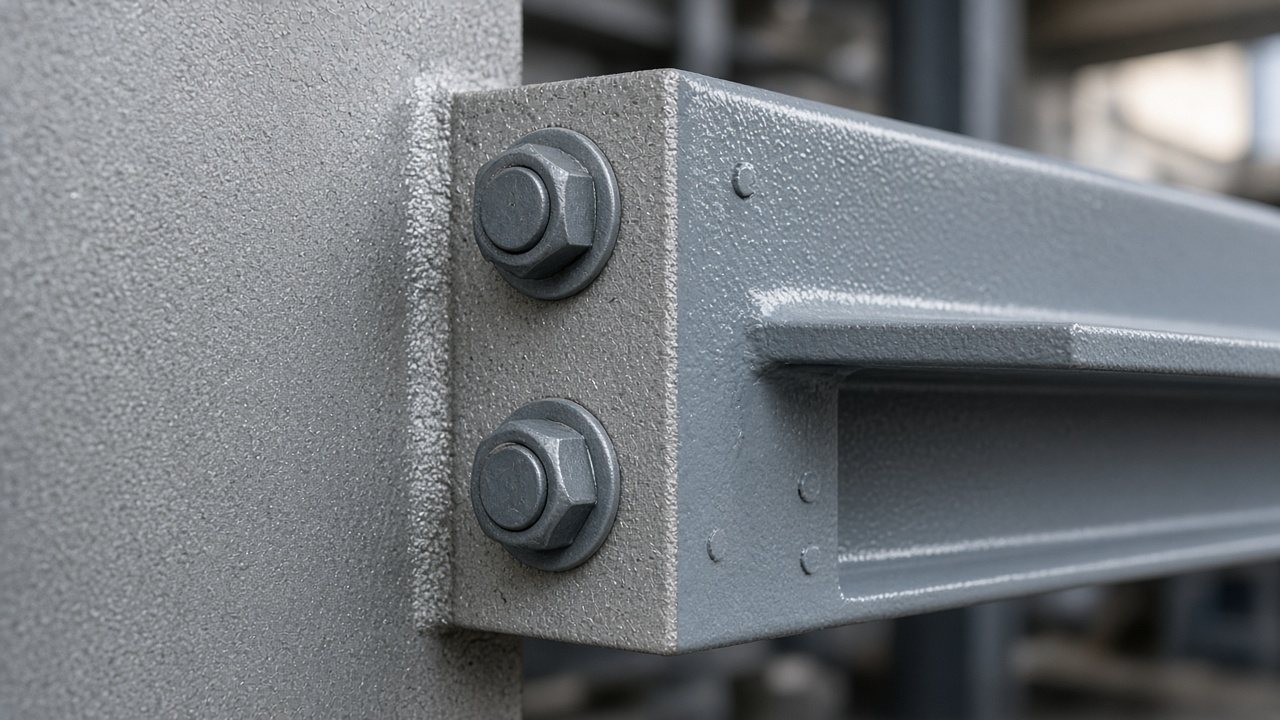
An industrial coating system, the kind used on steel in Kansas City plants, is a stack of coats that each do one job: a primer that bonds to the prepared steel and fights corrosion, an intermediate coat that acts as a barrier, and a topcoat that takes the sun and weather.
Why steel needs a coating at all
NASA's corrosion laboratory at Kennedy Space Center defines corrosion as the degradation of a metal due to a reaction with its environment. Metals corrode, NASA explains, because they are used in environments where they are chemically unstable. Iron is refined out of ore into a metal, and from then on it keeps tending back toward a more stable mineral form. Rust is the result.
A Federal Highway Administration study of bridge steel names the ingredients: steel corrodes when exposed to moisture and oxygen, and the process speeds up a great deal when salts are present. NASA adds that the reduction of oxygen is involved in the great majority of corrosion reactions. Take away the water and oxygen at the surface and corrosion slows down.
NASA notes that most large metal structures are made from carbon steel, which it calls the world's most useful structural material: inexpensive, readily available and easily formed. Protective coatings are one of the ways to control its corrosion.
The primer: bond and corrosion protection
The primer is the coat that touches the steel, so it has to bond to the prepared surface. In the three-coat system the federal study describes as typical for steel bridges, that first coat is a zinc-rich primer applied to abrasive blast-cleaned steel.
Zinc does more than seal. Because zinc is more reactive than iron, the study explains, it acts as a sacrificial anode and gives the steel cathodic protection. NASA's corrosion pages describe the same effect from the other direction: connect zinc and another metal in a corrosive solution, and the zinc corrodes faster while the other metal is protected. In a primer, the zinc gives itself up first.
That only works if the primer is in contact with clean steel, which is why preparation matters so much. The surface preparation standards guide explains the cleanliness grades.
The intermediate coat: a barrier over the primer
The middle coat's job is to block. In the federal study's description, the intermediate coat is usually an epoxy that acts as a barrier to protect the primer. It adds film between the weather and the zinc, slowing the water, oxygen and salts that would otherwise reach the primer and use it up.
The topcoat: sun, weather and appearance
The topcoat is the layer that faces the world. The federal study says it protects the coats beneath from deterioration caused by ultraviolet radiation and improves appearance. Sunlight breaks down many coating films, and the topcoat is chosen to take that exposure so the barrier and primer underneath do not have to.
Gloss is one way to watch a topcoat age. The same study notes that gloss reduction indicates the coating film has degraded, that all coatings lose gloss over time, and that high quality UV-resistant topcoats can hold their gloss for a long time in a properly applied system.
Film thickness: too thin and too thick both fail
A coating system is not just the right products in the right order. Each coat has to go on at the right thickness. The federal study calls dry film thickness an important measurement of a coating's performance. If the film is too thin, the steel underneath is not protected. If it is too thick, solvents can be trapped in the film, and the coating may crack or fail to cure properly.
In that study, one system was applied far thinner than its maker recommended, and the report says its poor performance could be attributed to the insufficient film. Blisters, rust pits and rust creeping from a scribed line developed on some of those panels. The coating's data sheet states the thickness each coat should reach.
One, two or three coats: what a federal bridge study found
Fewer coats save money up front. The federal study notes that application cost can be significantly reduced with one- or two-coat systems, along with time and space savings. But in its accelerated and outdoor tests, the three-coat systems performed better than the one- and two-coat systems.
That is a bridge study, and a plant is not a bridge. A dry interior column carries less exposure than an outdoor girder, and a pipe rack over a wash line may carry more. The study shows the trade-off clearly: fewer coats cost less to apply, and more coats protected best on bridge steel.
What federal rules call an industrial maintenance coating
Federal rules give heavy-duty coatings their own category. Under 40 CFR 59.401, an industrial maintenance coating is a high performance architectural coating, including primers, sealers, undercoaters, intermediate coats and topcoats, made for surfaces exposed to one or more extreme conditions in industrial, commercial or institutional settings.
That category has its own limit on volatile organic compounds. The US EPA's national rule limits the VOC content of architectural coatings, and the duty sits with manufacturers and importers. As published, Table 1 to Subpart D of Part 59 sets the limit for industrial maintenance coatings at 450 grams per liter (3.8 pounds per gallon) and for high temperature coatings at 650 grams per liter (5.4 pounds per gallon). Check a product's stated VOC content against that limit before it is chosen.
Matching the system to the exposure
The five conditions in the federal definition make a useful checklist when deciding what a coating has to stand up to:
- Immersion in water or chemical solutions, as in a tank or a sump.
- Corrosive agents, such as chemical fumes, process splash or washdown chemicals.
- Repeated heat above 250 °F, as on ovens, dryers or hot piping.
- Repeated heavy abrasion, as on steel that takes impact or wear.
- Exterior exposure of metal structures, such as outdoor steel, tank shells and silos.
Continuous or intermittent heat above 400 °F is its own category, high temperature coatings. The more conditions a surface faces, the more the choice of system matters. The structural steel and equipment painting page covers plant steel, and the silo painting page covers outdoor metal structures.
Paint and galvanizing are different kinds of coating
Not every protective coating is paint. NASA notes that protective coatings can be metallic, such as galvanized steel, or applied as a liquid paint. Galvanized steel can also be painted, and it has its own preparation standard for that, SSPC-SP 16, which roughens and cleans galvanized and other non-ferrous surfaces to create a profile suitable for paint, as the American Galvanizers Association summarizes it.
Coating system questions
How long does an industrial coating system last?
There is no single figure. The one federal number we can cite is about 30 years before field rehabilitation for a three-coat system on a new steel bridge, from the Federal Highway Administration study. A plant's exposure can be easier or harder than a bridge's, so that figure is not a promise for plant steel.
Is a zinc-rich primer the same as galvanizing?
No. A zinc-rich primer is a paint coat that contains zinc, while galvanizing is a metallic coating on the steel itself.
Does every job need three coats?
No. Systems with one and two coats exist and cost less to apply. The exposure and the specification decide how many coats a surface needs.
When coatings go wrong, the guide to why industrial coatings fail explains the documented causes. More guides are on the industrial painting guides page.
Sources
- American Galvanizers Association, SSPC Surface Preparation Standards, April 30, 2014, updated 2025, read 2026-11-28
- Federal Highway Administration, Coating Performance on Existing Steel Bridge Superstructures, FHWA-HRT-20-065, September 2020, read 2026-11-28
- NASA Kennedy Space Center, Corrosion Fundamentals, read 2026-11-28
- NASA Kennedy Space Center, Corrosion Control, read 2026-11-28
- 40 CFR 59.401, Definitions, Legal Information Institute copy, read 2026-11-28
- 40 CFR 59.402 and Table 1 to Subpart D of Part 59, Legal Information Institute copy, read 2026-11-28
- US EPA, Architectural Coatings: National Volatile Organic Compounds Emission Standards, last updated March 4, 2026, read 2026-11-28
Ask about a coating system for your steel
Tell us what the steel is exposed to and send photos through the coating system quote form, and we will answer with a written quote or with questions.